Tell us about the job
Takes about a minute. No obligation.
A contractor quoting a furnace installation in Barry County is not working against a backdrop of relentless storm load. 36 severe weather events were recorded in Barry County, Michigan between 2015 and 2024. At that rate, severe weather is an event in this county, not a standing condition, which means the decisions that shape a correct install, how a system is sized, how ducts are configured, what the building envelope actually demands, come down to the house itself and the local heating season. A furnace put in correctly here will carry a load defined mostly by cold Michigan winters, not by accumulated weather damage, and a contractor who quotes it that way is quoting it honestly.
Ductwork sized and routed for an older generation of furnaces is what a contractor runs into in much of Barry County. Half the homes in Barry County, Michigan were built in 1976 or earlier (2020-2024 ACS 5-year). A modern furnace moves air at volumes and static pressures that the original trunk lines were never laid out to handle, which means the duct system gets pressure-tested and measured before any equipment is selected or priced. Where the ductwork passes, the electrical panel gets the same attention. The age of the building sets the agenda for that first visit.
What Gets Installed With a New Furnace
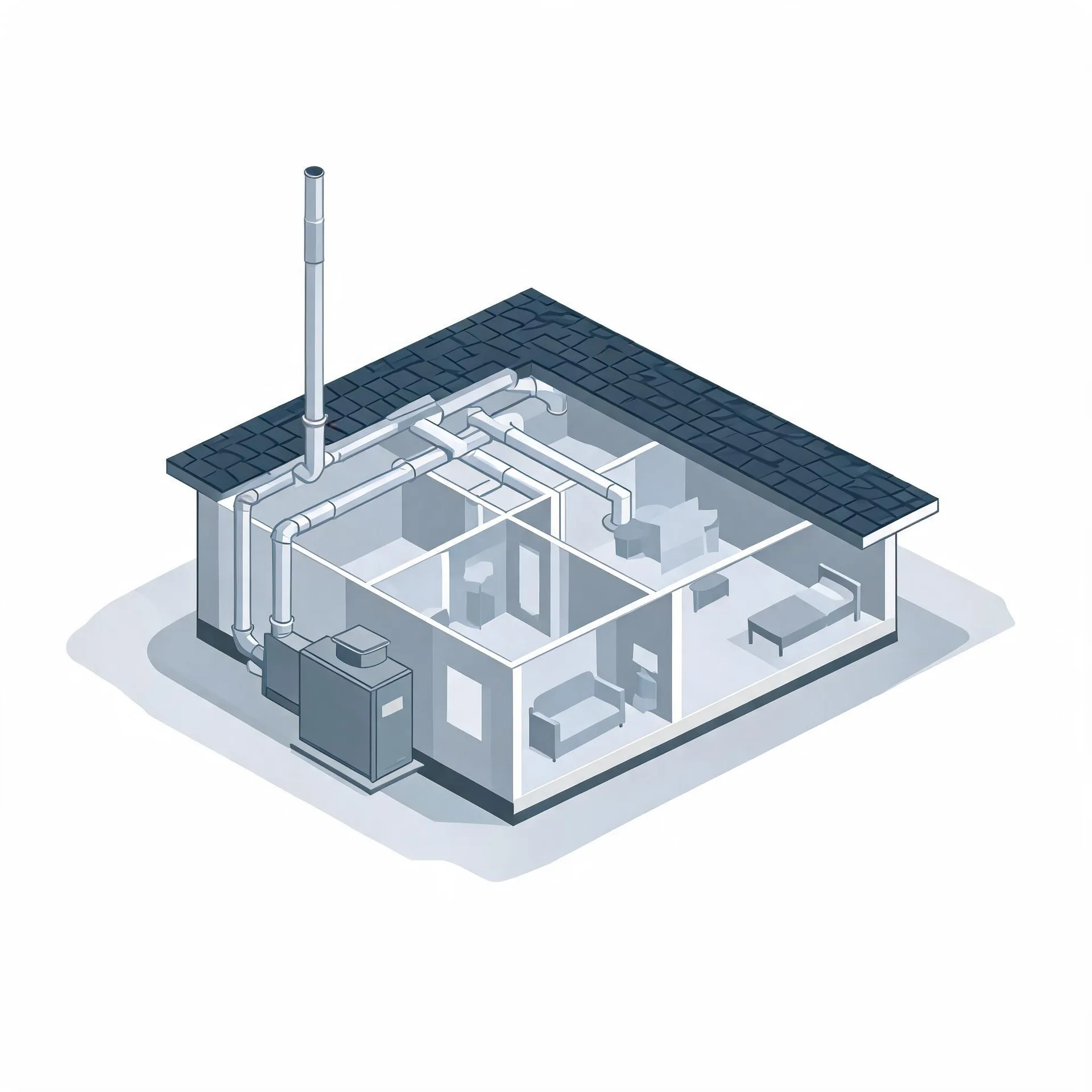
The furnace itself sits in the basement, utility room, or crawlspace and is the unit that produces heat. A heat exchanger inside it transfers heat to the air moving through, and a burner assembly below that feeds it. The flue pipe runs from the furnace up and out of the house, carrying combustion gases outside.
The blower motor sits inside the furnace cabinet and pushes conditioned air out into the home. A filter housing attaches at the air intake side, catching dust before it reaches the heat exchanger. The thermostat mounts on an interior wall and is the control point that tells the furnace when to fire.
The drawing shows a typical layout, and a licensed contractor determines exactly what applies to this house.
Find a contractor in Barry CountyBarry County, Michigan, by the numbers
36 severe weather events were recorded in Barry County, Michigan between 2015 and 2024.
NOAA National Centers for Environmental Information, Storm Events Database, bulk CSV export, events 2015-01-01 through 2024-12-31.Half the homes in Barry County, Michigan were built in 1976 or earlier (2020-2024 ACS 5-year).
U.S. Census Bureau, 2020-2024 American Community Survey 5-Year EstimatesBarry County, Michigan holds 27,780 housing units (2020-2024 ACS 5-year).
U.S. Census Bureau, 2020-2024 American Community Survey 5-Year EstimatesOwners occupy 87.3% of the occupied homes in Barry County, Michigan (2020-2024 ACS 5-year).
U.S. Census Bureau, 2020-2024 American Community Survey 5-Year EstimatesFurnace Installation Rules That Apply in Barry County, Michigan6 sourced standards and codes
What the Installation Actually Looks Like
Non-weatherized gas furnaces manufactured on or after November 19, 2015 must reach 80.0 percent AFUE.
Non-weatherized oil-fired furnaces manufactured on or after November 19, 2015 must reach 83.0 percent AFUE.
Mobile home gas furnaces manufactured on or after November 19, 2015 must reach 80.0 percent AFUE.
Non-weatherized gas furnaces manufactured on or after December 18, 2028 must reach 95.0 percent AFUE, up from the 80.0 percent minimum that applies to units manufactured before that date.
Licensing and Legal Requirements in Barry County, Michigan
Michigan issues the mechanical contractor’s licence by classification: HVAC equipment, ductwork, refrigeration, hydronic heating and cooling, and limited or unlimited heating and refrigeration service are each a separate classification a contractor has to hold.
Michigan requires a mechanical contractor’s licence: nobody may install, alter or service the regulated mechanical work unless they, or an employee, hold a licence from the department that has not been revoked or suspended.
Severe Weather Events in Barry County
Barry County's weather places real demand on residential heating equipment, and that demand shapes what a furnace needs to handle over its working life. Installation decisions made here are local decisions, and the pattern of recorded weather events is part of what informs them.
36 severe weather events, 2015–2024. Source: NOAA National Centers for Environmental Information, Storm Events Database.